My Books on Amazon






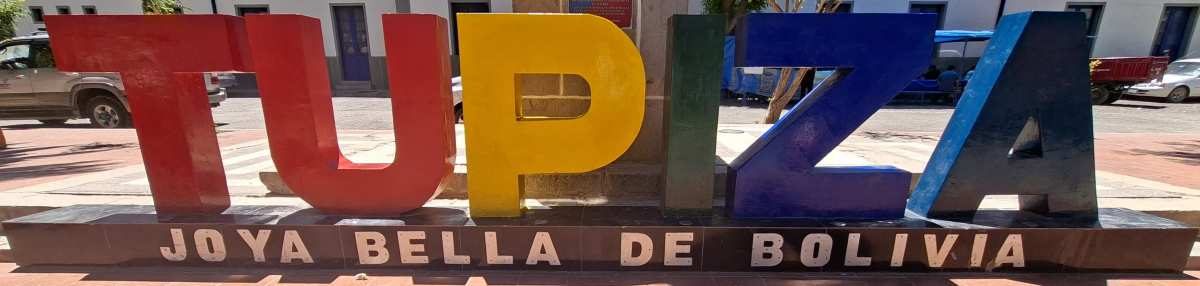
Tupiza, BO - One of a Few I Like in Bolivia
November 12, 2026
Tupiza, Bolivia, has a population of around 45,000 and sits in Southern Bolivia at an elevation of 2949 meters (9675 feet). That's quite high, so nights do get cold. But now we're coming into spring, so it's not as bad as in the winter (June/July/August) - nights drop below zero. This town has been a bit of a surprise in that it's quite a pleasant town.
Small Town, Long History
Long before the Spanish arrived, the Tupiza valley belonged to the Chichas, one of the oldest native peoples of the southern Bolivian Andes. Archaeological and ethnohistorical studies by María Beierlein have established that Tupiza predates the Spanish, and that it was one of the most important population centers of the Chicha culture. The Inca Empire arrived late in the story. The Incas reached the Chichas region roughly between 1490 and 1510, and the valley became part of their road network.
References: correodelsur
USFX
The Spanish came through early. Because Tupiza lay along the Inca road system, Diego de Almagro’s expedition to Chile used it as a place to regroup before pushing farther south, arriving in late 1535 and leaving in January 1536. The town’s founding date is still a matter of debate. The official version holds that Luis de Fuentes y Vargas founded it on June 4, 1574, while on his way to establish Tarija, but other accounts place a founding in 1535–1536 with Almagro’s expedition, and some historians argue it was never founded at all, since it already existed when the Spanish arrived. Supporting the earlier claims, notarial documents mention Spaniards living in Tupiza as early as 1539, the same year Chuquisaca (today’s Sucre) was founded, making it one of the oldest colonial settlements in present-day Bolivia.
Una Belleza de la Bella Tierra de los Chichas
Hispanopedia
Mining shaped the town’s fortunes for nearly a century. By the late 19th century, Tupiza had become a key hub for mining in southern Bolivia, and prominent firms such as the Aramayo company set up offices there. That wealth drew the town’s most famous visitors. Early on November 3, 1908, Aramayo manager Carlos Peró left Tupiza with his teenage son and a servant to carry the company payroll to its headquarters in Quechisla, a three-day trip. Two English-speaking bandits held them up near Huaca Huañusca. After a shootout in the mining village of San Vicente a few days later, the two outlaws were buried in the local cemetery, and the Aramayo payroll was found intact in their saddlebags. Most historians accept that the pair were Butch Cassidy and the Sundance Kid, although Tupiza officials who conducted an inquest were never able to establish the dead men’s names, and rumors of Butch’s survival persisted for decades.
References: Todo Jujuy
True West Magazine
The mining era eventually faded. Once a thriving mining center, Tupiza today is mainly a commercial and trade hub, though some nearby mining operations survived the collapse of tin prices in the mid-1980s. The 2024 census counted 45,590 residents in the municipality, and the fertile valley remains important for producing corn, fruit and vegetables, much as it was in the days of the Chichas.
Reference: Britannica
This is Tupiza
Tupiza sits in a valley surrounded by steep stone cliffs, some brown, some red. The Tupiza River runs through the town, though right now it is little more than a stream. The town has a few nice parks and plazas, but along the river they've done no development of park/green space. There are no buildings to be moved, though, so if and when they get the money for a malecon (boardwalk/esplanade/etc.) the work should be fast and easy. The town has a train, of sorts. It's more of a bus body mounted on train wheels. They call it a buscarril, literally a "bus-rail." It has the bus-style headlights, grille, windshield, and side mirrors, and a roof rack for luggage. From Tupiza, it runs north to the town of Atocha. From Atocha, there is another that runs north to Uyuni. But you have to time your visit perfectly - each route runs only twice a week. It’s built for people passing through, not for day-trippers, meaning if you take the train for a few hours visit at the other end of the line, you'll be taking a bus or shared taxi for the return trip.
Tupiza is a pleasant town, and of the 25 towns/cities I've visited so far in Bolivia, I've said that about only 2 other cities. I have to admit, I don't care much for Bolivia.

I used to teach English as a foreign language in Barranquilla, Colombia. Now I'm retired and traveling throughout South America.
I'm from Kennewick, Washington, USA. In my previous life, as I call it, I was an IT guy, systems administrator, computer tech, as well as a shipping/receiving guy and also worked as a merchandising guy in a RV/Camping store.