My Books on Amazon






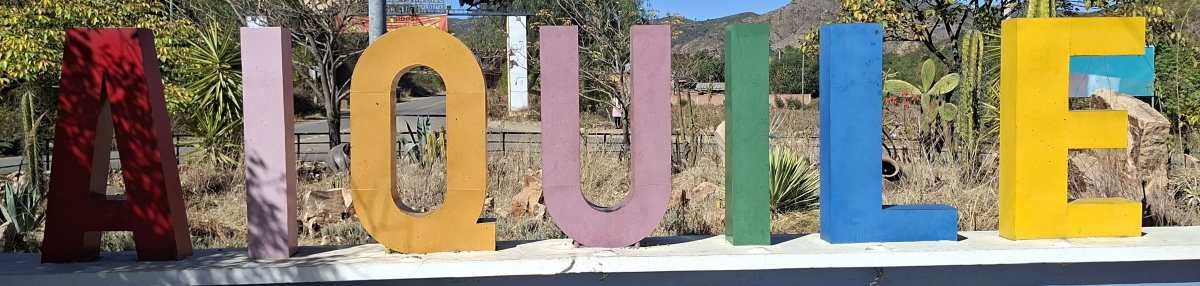
Aiquile, BO
June 23, 2026
Aiquile, Bolivia, is a town of about 27,000 sitting at an elevation of about 2260 meters (7400 feet), in a valley on the eastern side of the Andes Mountains. The vast majority of the population is indigenous Quechua and speaks the Quechua language. Most of the younger population also speaks Spanish, while most of the older generations do not.
The town is quite pleasant, something actually rare in my experiences in Bolivia (I now know 18 cities in Bolivia). Of the towns I know, there are 2 (Aiquile and Samaipata) that I actually like, plus one community that isn't actually even a town (Santiago de Chiquitos).
Home of the Charango
Aiquile has several monuments to the Charango. Charangos are a version of guitar, a bit smaller than a typical acoustic guitar. Aiquile is officially considered the National Capital of the Charango in Bolivia, and the town has spent decades building that identity. Many residents are charango makers, and Aiquile hosts the annual National and International Charango Festival, which has been running since the 1980s. Yet, Potosí as the traditional "cradle" or birthplace of the charango. Aiquile also has the Museo Nacional del Charango. The museum contains hundreds of charangos, including festival-winning instruments and highly elaborate carved examples. It also houses a small archaeological collection from pre-Hispanic cultures of the region.
A Surprising Climate at the Edge of the Andes
Something else that surprised me about this town - Aiquile sits in one of Bolivia's odd little climate pockets. Being at more than 2000 meters elevation, you'd expect it to have highs in the low to maybe mid-20s °C (generally around the low 70s °F). But no. I'm here in June, middle of winter, and the daily temps are around 28 - 30 °C (mid 80s° F).
Aiquile lies in a relatively dry intermontane valley on the eastern side of the Andes, where several factors work together:
- Strong solar radiation. At 2,250 m, the atmosphere is thinner, so daytime heating is intense.
- Valley sheltering. The surrounding mountains block cooler air masses and winds.
- Dry air. Dry air heats rapidly during the day and cools rapidly at night.
- Eastern-Andes influence. It's far enough east that it starts feeling some of the warmer influences coming up from Bolivia's lowlands.
This combination produces a climate that's warmer than you'd expect from elevation alone. Bolivia has several of these "warm mountain valleys." They're often major fruit-growing regions because the temperatures are surprisingly mild and frost is uncommon compared to the higher Altiplano.
If you stop in Aiquile, be sure to stop at Fruta Fria Heladeria. This ice cream shop is where you'll find proper artisan ice cream, made the old-fashioned way—by hand in a hand-crank ice cream maker bucket thing. And it's delicious. And Karen, the young woman running the shop, is a sweetheart. At the Plaza Principal across from the church (not the park by the mercado, but the other one a couple of blocks away) is a coffee shop that you should visit even if you don't drink coffee. It's called La Casa del Cafecito. Inside, you'll find loads of stuff from England to look at while waiting for your drink or sandwich.
So, should you add Aiquile to your list of stops in Bolivia? Only if you're a musician and interested in visiting the museum of Charangos. Otherwise, there's nothing here for tourists and few, if any, English-speaking people. And, if you're a foreigner, you will attract a lot of "looks" from the locals. But they are friendly, and this is a pleasant town to visit, even if it's just a stop along the way.

I used to teach English as a foreign language in Barranquilla, Colombia. Now I'm retired and traveling throughout South America.
I'm from Kennewick, Washington, USA. In my previous life, as I call it, I was an IT guy, systems administrator, computer tech, as well as a shipping/receiving guy and also worked as a merchandising guy in a RV/Camping store.